The Hyundai Staria Camper Concept brings together two things that are becoming increasingly popular: electric vehicles and campervans.
Unveiled at the 2026 CMT Stuttgart show, the Hyundai Staria Camper Concept is a factory-built electric campervan concept designed to show how Hyundai could turn its STARIA Electric into a practical vehicle for weekends away and longer adventures.
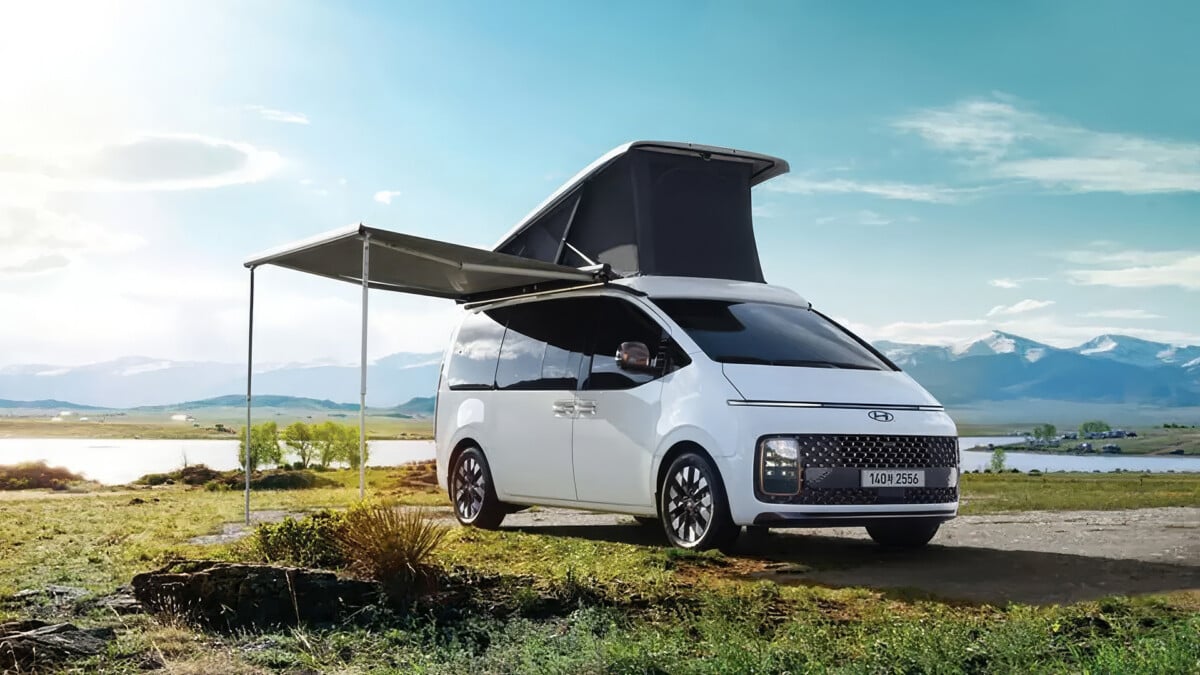
Rather than being a traditional van conversion, the concept integrates its camping equipment into the vehicle from the start. It features a powered pop-up roof, flexible seating, a kitchen area, solar charging and a range of features designed for off-grid camping.
The Hyundai Staria Camper Concept is still only a concept, so Hyundai has not confirmed that it will enter production. However, it provides an interesting look at what a future electric campervan from Hyundai could look like.
Hyundai Staria Camper Concept: Designed for Adventure
The STARIA already has the shape and interior space needed to make a convincing campervan. Hyundai’s concept takes advantage of that by creating a camping-focused interior without turning the vehicle into a complicated aftermarket conversion.
At the heart of the design is a fully integrated, power-operated pop-up roof. When raised, it provides additional headroom and creates sleeping space while keeping the vehicle relatively compact when driving.
The rear seats can also fold flat to create a bed, allowing the same interior to be used for travelling during the day and sleeping at night.
This approach gives the Hyundai Staria Camper Concept a more polished feel than many conventional van conversions.
If you’re interested in the idea of converting a van into a camper yourself, our guide to the best vans to buy to convert into a campervan looks at some of the alternatives available to buyers.
A Pop-Up Roof With a Difference
The electrically operated pop-up roof is one of the most noticeable features of the concept.
It can be raised when the vehicle is parked, providing additional space inside and helping create a more comfortable sleeping area.
Hyundai has also incorporated smart glass into the concept, while a dedicated camping control touchscreen allows various functions to be managed from inside the vehicle.
The result is an interior that is designed specifically around camping rather than simply adding camping equipment to a standard van.
The Hyundai Staria Camper Concept also uses the roof as more than just a way of creating additional interior space. It houses a solar panel that forms an important part of the vehicle’s off-grid technology.
Solar Power for Off-Grid Camping
One of the most interesting features of the Hyundai Staria Camper Concept is its solar charging system.
A lightweight composite solar panel measuring 520W is integrated into the roof. Hyundai says it can generate up to 2.6kWh of energy per day based on around five hours of average sunlight.
That energy can either help extend the vehicle’s driving range or be used to power camping equipment.
The concept can use solar energy for features including its 36-litre refrigerator and portable shower.
For campers who want to spend time away from campsites and mains electricity, this could be particularly useful.
Of course, real-world solar generation will depend heavily on weather, location, season and how much sunlight the vehicle receives. The quoted 2.6kWh figure should therefore be treated as a figure supplied by Hyundai under its stated conditions rather than something owners would necessarily achieve every day.
This is one of the areas where the Hyundai Staria Camper Concept differs from a conventional campervan. Instead of relying entirely on an external electrical hookup, it has been designed to generate some of its own energy.
Electric Powertrain: The STARIA Electric Foundation
The Hyundai Staria Camper Concept is based on the STARIA Electric, giving it a fully electric foundation rather than relying on a conventional diesel or petrol engine.
The STARIA Electric uses an 800V electrical architecture and a 160kW electric motor producing 218PS.
Hyundai quotes a charging time of around 20 minutes from 10% to 80% when using suitable DC fast-charging equipment and under optimal conditions.
The standard STARIA Electric has an estimated WLTP range of up to around 400km, or approximately 248 miles. However, this is the figure for the standard STARIA Electric rather than a confirmed range for a production camper version.
Adding camping equipment and the additional weight associated with a camper conversion could affect efficiency and range.
That makes the Hyundai Staria Camper Concept particularly interesting because it demonstrates how Hyundai could adapt an existing electric vehicle platform for leisure use.
It also means potential buyers shouldn’t assume that the 248-mile figure will necessarily apply to a production camper. Hyundai has not announced a production specification or official range for the camper concept.
What Is the Interior Like?
Hyundai has designed the interior around flexibility.
The rear seating can fold down to create a sleeping area, while storage compartments and a compact kitchen area are integrated into the cabin.
The kitchen includes a sink and refrigerator, giving occupants the basic facilities needed for longer trips.
There’s also a portable shower and privacy arrangement, making it possible to use the vehicle for more remote adventures without relying entirely on campsites.
The concept’s camping control system is another useful touch. It brings various functions together through a touchscreen, allowing occupants to control features such as the roof and rear seating.
The two front captain’s chairs can also rotate towards the rear, helping create a more lounge-like environment when the vehicle is parked.
This is important because one of the biggest challenges with campervans is making a relatively small interior feel practical without filling it with equipment.
The Hyundai Staria Camper Concept appears to have been designed around that principle, with multiple functions integrated into the vehicle rather than relying on removable camping equipment.
Off-Grid Camping Without the Compromises?
The Hyundai Staria Camper Concept is clearly aimed at people who want to travel without being tied to campsites.
The solar panel is central to that idea. Instead of depending entirely on a campsite electrical hookup, solar energy can help run some of the vehicle’s camping equipment.
The electric powertrain also means there are no exhaust emissions from the vehicle while driving.
However, an electric camper still has some of the same challenges as any large electric vehicle.
Long-distance journeys require access to suitable charging infrastructure, while additional weight and aerodynamic changes can affect efficiency.
For UK campers travelling between campsites and charging stops, that may not be a major issue. For those wanting to spend several days completely off-grid, charging and energy management would become much more important.
The Hyundai Staria Camper Concept therefore looks particularly suited to a style of camping where solar power supplements the vehicle’s main electrical system rather than completely replacing the need for charging.
How Does It Compare With Other Campervans?
The Hyundai Staria Camper Concept would enter an increasingly competitive market if it eventually reaches production.
Camper
Powertrain
Camping approach
Hyundai Staria Camper Concept
Fully electric
Factory-integrated concept
Volkswagen ID. Buzz Camper
Fully electric
Camper-focused electric van
Nissan e-NV200 conversions
Fully electric
Aftermarket conversion
Mercedes EQV conversions
Fully electric
Premium aftermarket conversion
The biggest difference is that Hyundai’s concept has been designed as a complete camper from the outset.
That could potentially give it advantages in terms of integration, usability and overall appearance compared with an aftermarket conversion.
The Volkswagen ID. Buzz is perhaps its most obvious electric rival, although camper versions and specifications vary depending on the market and conversion.
For buyers who don’t necessarily want a brand-new electric camper, there is also the option of looking at an existing used EV. Our guide to buying a used electric car covers some of the key advantages and disadvantages to consider.
Could the Hyundai Staria Camper Come to the UK?
This is where things become less certain.
Hyundai has not confirmed a UK production version of the Hyundai Staria Camper Concept, and there is currently no confirmed UK launch date.
The vehicle shown at CMT Stuttgart was presented as a concept study intended to explore future possibilities.
That means previous speculation about a specific UK launch date or price should not be treated as confirmed information.
The STARIA Electric itself provides a realistic basis for the concept, but Hyundai would still need to decide whether there is sufficient demand for a factory-built electric camper.
The UK could be an interesting market for such a vehicle, particularly as electric vans become more established and demand for campervans continues.
What Could a Production Version Cost?
Hyundai has not announced a price for a production version of the Hyundai Staria Camper Concept.
It would therefore be misleading to give a firm UK price at this stage.
A production camper would inevitably cost more than the underlying van because of the additional equipment, interior conversion, solar system, pop-up roof, kitchen and other camping technology.
The final price would also depend on battery size, specification and whether Hyundai offered different versions.
For now, any specific UK price should be treated as speculation rather than an official figure.
Why the Hyundai Staria Camper Concept Matters
Electric campervans are an interesting challenge for manufacturers.
A normal electric car can be relatively efficient because it is designed around aerodynamics and weight. A campervan is much larger, heavier and usually carries additional equipment.
That makes efficiency more difficult to achieve.
Hyundai’s concept shows one possible solution: use a relatively large electric vehicle, add solar generation and design the camping equipment around efficient use of available space.
The solar system won’t replace the need to charge the vehicle, but it could reduce the amount of external electricity needed for some camping equipment.
The concept also demonstrates that electric campervans don’t necessarily have to rely on aftermarket conversions.
A factory-built model could potentially offer better integration between the vehicle’s electrical systems and its camping equipment.
Could an Electric Camper Really Work in the UK?
For many UK drivers, an electric camper could make sense.
A typical weekend trip might involve driving to a campsite, staying for a night or two and then returning home. In that situation, the ability to charge at home before leaving and use public charging during longer journeys could make an electric camper practical.
The biggest question would be range.
Campervans tend to carry more weight than standard passenger vehicles, and the additional equipment can affect efficiency. Cold weather, motorway speeds and heavy loads can also reduce an electric vehicle’s real-world range.
However, the technology is developing quickly.
The Hyundai Staria Camper Concept shows that manufacturers are beginning to consider how electric vehicles could be adapted for leisure use rather than concentrating solely on commercial applications.
For someone considering an electric camper, charging availability would be just as important as the headline range. A vehicle with a shorter range but easy access to rapid chargers could potentially be more useful for touring than one with a longer quoted range but limited charging options.
Hyundai Staria Camper Concept: What Happens Next?
For now, the Hyundai Staria Camper Concept remains exactly that: a concept.
Hyundai has not confirmed production, a UK launch date or pricing.
However, the concept gives us a good indication of the direction Hyundai is exploring. A fully electric camper with an integrated pop-up roof, solar charging, flexible interior and off-grid equipment could offer something genuinely different from traditional campervans.
Hyundai has published further information about the concept, including its solar charging system, interior layout and electric technology, on its official STARIA Camper Concept page.
The Hyundai Staria Camper Concept is therefore one to watch if Hyundai decides that there is enough demand to turn the idea into a production vehicle.
Final Thoughts
The Hyundai Staria Camper Concept is an intriguing look at what an electric campervan could become.
Its biggest strengths are the integrated design, flexible interior, 520W solar panel and fully electric powertrain. The pop-up roof and fold-flat rear seats also make clever use of the available space.
There are still plenty of unanswered questions, particularly around production, UK availability, pricing and the real-world range of a fully equipped camper.
For now, it remains a concept rather than a vehicle you can order. But if Hyundai does decide to put the idea into production, the Staria could become a very interesting alternative for drivers looking for a modern electric campervan.
MotorHype is a UK used car platform. Buy or sell with no fees, no commission, no hidden catches. Search thousands of cars or list yours in minutes. Drive smarter, not harder.
MotorHype is a trading name of Hype Matrix Limited, 128 City Road, London, EC1V 2NX. All rights reserved.
Login
Register
Log in to your account
Welcome back! Sign in to your account
or
Register
Create a free MotorHype account today
Manage Consent
To provide the best experiences, we use technologies like cookies to store and/or access device information. Consenting to these technologies will allow us to process data such as browsing behaviour or unique IDs on this site. Not consenting or withdrawing consent, may adversely affect certain features and functions.
Functional
Always active
The technical storage or access is strictly necessary for the legitimate purpose of enabling the use of a specific service explicitly requested by the subscriber or user, or for the sole purpose of carrying out the transmission of a communication over an electronic communications network.
Preferences
The technical storage or access is necessary for the legitimate purpose of storing preferences that are not requested by the subscriber or user.
Statistics
The technical storage or access that is used exclusively for statistical purposes.The technical storage or access that is used exclusively for anonymous statistical purposes. Without a subpoena, voluntary compliance on the part of your Internet Service Provider, or additional records from a third party, information stored or retrieved for this purpose alone cannot usually be used to identify you.
Marketing
The technical storage or access is required to create user profiles to send advertising, or to track the user on a website or across several websites for similar marketing purposes.